

When most people think about property taxes, they picture hefty annual bills that rival a car payment. But here’s the counterintuitive reality that surprises nearly every first-time land buyer: understanding the rural land property taxes guide principles is essential for calculating your true ownership costs and making smart investment decisions. A 5-acre parcel of vacant rural land might carry an annual tax bill significantly lower than a suburban home on a quarter-acre lot.
The difference isn’t a typo or a temporary tax break. It’s a fundamental feature of how property taxes work on vacant land. Because unimproved rural property lacks structures, infrastructure connections, and the municipal services that drive up residential tax assessments, the carrying costs remain remarkably low year after year.
This guide walks you through everything you need to know about property taxes on rural land. You’ll learn about assessment cycles, calculation methods, county-by-county variations, and special exemptions that can reduce your bill even further.
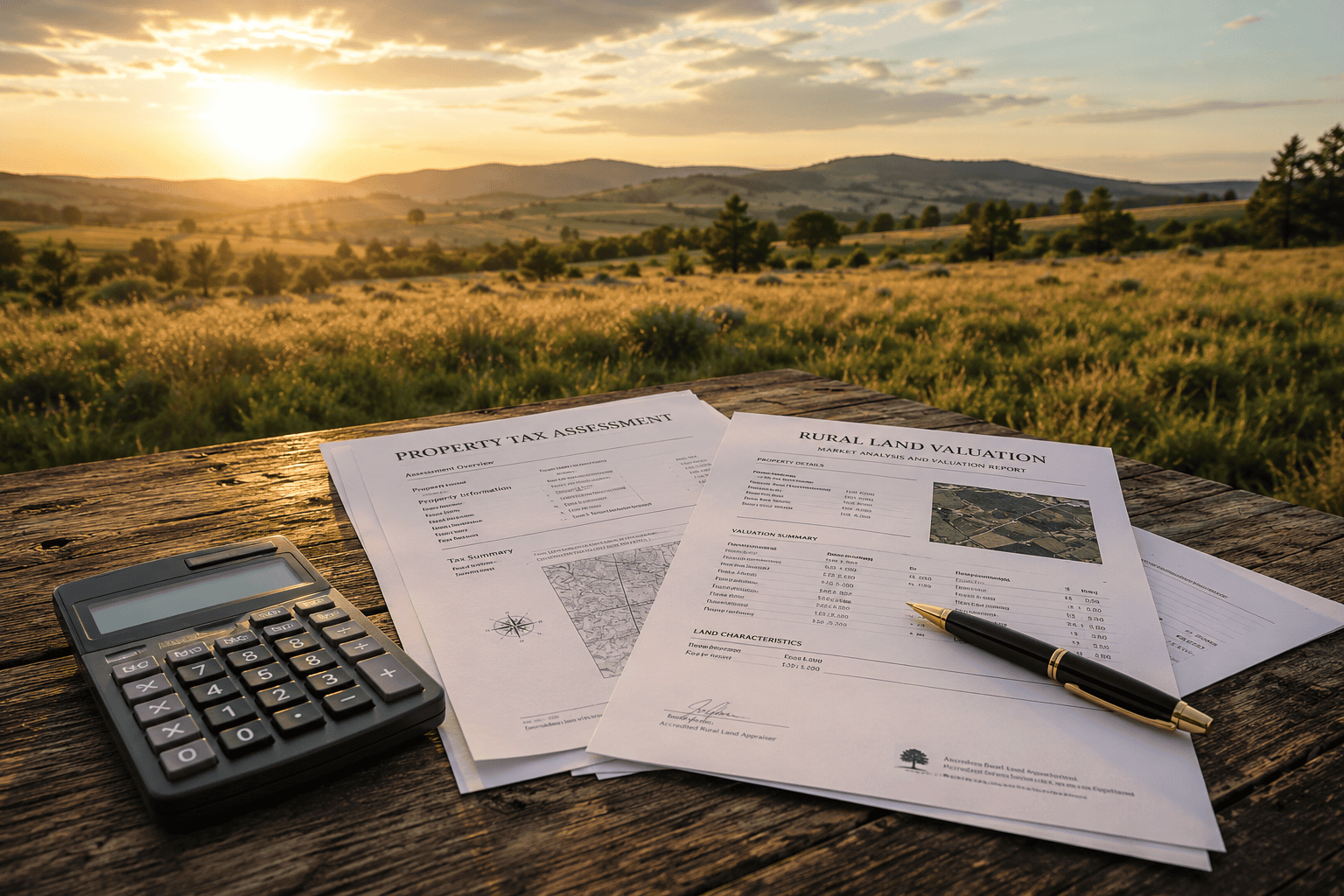

LandFix makes rural land ownership affordable with transparent costs
Understanding the Property Tax Assessment Timeline
Property tax cycles follow a predictable annual pattern, though specific dates vary by state and county. Most counties assess property values once per year, typically using January 1st as the assessment date. This means the condition and use of your land on that specific date determines your tax bill for the coming year.
After assessment, counties send appraisal notices in spring or early summer. Property owners then have a window—usually 30 to 60 days—to appeal the assessed value if they believe it’s incorrect. Following the appeal period, counties calculate the final tax bills by applying the current millage rate to assessed values.
Tax bills are typically issued in late summer or fall, with payment due dates ranging from November through January depending on your location. Some counties offer semi-annual payment options, splitting the bill into two installments.
When you purchase land, tax responsibility is prorated at closing. The seller pays taxes for the portion of the year they owned the property, and you’re responsible from your closing date forward. Your title company or closing attorney handles this calculation, ensuring both parties pay their fair share. For more details on the closing process, you can find answers in our FAQ.
Understanding this timeline helps you budget appropriately and avoid surprises. According to IRS property tax deduction guidelines, these taxes may be deductible depending on your situation.
How Vacant Land Assessment Actually Works
Property tax assessments for vacant land operate on fundamentally different principles than improved properties. When affordable rural land tax assessment explained in simple terms, assessors classify land first by its use—agricultural, residential, commercial, or undeveloped—then apply valuation methods appropriate to that classification.
Vacant rural land typically lacks the value drivers that inflate residential property assessments. There’s no structure to depreciate or appreciate, no square footage of living space to calculate, and no comparable home sales to benchmark against. Instead, assessors look at raw land sales in the area, soil quality, access, topography, and potential uses.
This results in assessed values that often run substantially lower than similar acreage with structures. The difference between vacant land and improved property assessments can be significant, making raw land an affordable ownership option.
It’s crucial to understand that assessed value and market value are different figures. Market value represents what a willing buyer would pay a willing seller. Assessed value is the figure your county uses for tax calculation purposes, typically a percentage of market value determined by state law and local assessment ratios.
The Three Factors That Determine Your Tax Bill
Calculating how to calculate property taxes rural property requires understanding three components that work together to produce your annual bill. Each component serves a specific purpose in the taxation formula.
Assessed Value is the dollar amount assigned to your property by the county assessor, based on land use classification, location, characteristics, and comparable sales. This is the foundation of your tax calculation.
Assessment Ratio is the percentage of assessed value that’s actually subject to taxation. Some states tax 100% of assessed value, while others tax only a portion. This ratio is set by state law and varies significantly by jurisdiction.
Millage Rate (also called mill levy or tax rate) is the amount of tax per $1,000 of taxable assessed value. One mill equals $1 of tax for every $1,000 of taxable value. Counties, school districts, fire districts, and other taxing entities each set their own millage rates, which are combined into a total rate for your parcel.
Here’s how these three factors work together in a real-world calculation:
Using this formula, you can estimate taxes on any property before purchasing. Most county assessor websites provide current millage rates, and you can verify the assessed value of specific parcels through their online databases.
County Property Tax Rates: Why Location Changes Everything
Property tax differences between counties land can be dramatic, even between neighboring jurisdictions. Counties have different governance structures, service levels, school district funding needs, and voter-approved levies that all contribute to the total millage rate.
A rural county with volunteer fire departments, minimal public services, and regional school consolidation might have lower total millage rates. Meanwhile, a county with professional emergency services, extensive road maintenance programs, and well-funded school districts might levy higher rates.
Special assessments add another layer of variation. Some counties impose additional charges for road maintenance, watershed protection, fire districts, library services, or hospital districts. These assessments can add several mills to your total tax rate.
The cumulative effect means neighboring counties can have substantial differences in property tax rates. This makes county selection a critical factor in long-term affordability. Smart buyers research not just the land itself but the tax environment where that land is located. You can see what parcels are available across different counties to compare total carrying costs.
| County, State | Millage Rate | Assessed Value (5 acres) | Annual Tax Bill | Special Exemptions |
|---|---|---|---|---|
| Mohave County, AZ | 9.2 mills | $8,500 | $78 | Agricultural use available |
| Luna County, NM | 11.5 mills | $6,200 | $71 | Veteran exemptions |
| Sharp County, AR | 14.8 mills | $9,800 | $145 | Homestead (improved only) |
| Levy County, FL | 18.3 mills | $11,400 | $209 | Greenbelt program |
| Hudspeth County, TX | 7.4 mills | $7,100 | $53 | Agricultural exemption |
Note: Rates and values shown are representative examples for comparison purposes. Actual rates change annually and vary by specific location within each county.
“I was shocked when my first tax bill came—$187 for the entire year on my 10-acre property. That’s less than I used to pay monthly in HOA fees at my condo. It made me realize how affordable land ownership really is when you get away from suburban developments.”
Agricultural, Greenbelt, and Special Exemptions Deep Dive
Beyond the baseline vacant land assessment, several programs can reduce your property taxes even further. Agricultural exemptions, greenbelt programs, and conservation easements offer substantial savings for landowners who meet specific criteria.
Agricultural exemptions provide the most common tax reduction for rural landowners. These programs recognize that working agricultural land generates income at levels that don’t support residential-level taxation. Requirements vary by state but typically include minimum acreage thresholds, documented agricultural activity, and sometimes minimum income levels from that activity.
Qualifying agricultural uses range from cattle grazing and crop production to beekeeping, timber production, and even wildlife management in some states. Texas, for instance, offers wildlife management as an agricultural use, allowing landowners to maintain tax benefits by managing habitat and documenting wildlife populations according to state guidelines.
Greenbelt programs offer similar benefits with different requirements. These programs, also called current use assessment or preferential assessment, tax land based on its current agricultural or forest use rather than its potential development value. This prevents landowners from being “taxed out” of agricultural property when surrounding development increases land values.
Conservation easements provide permanent tax reductions in exchange for restricting development rights. Landowners voluntarily limit what can be built or how land can be used, preserving agricultural, forest, or natural character in perpetuity. In return, the assessed value drops significantly, often reducing annual taxes substantially.
The reality is that many of these programs benefit larger operations or landowners committed to active agricultural use. The average recreational land buyer may not meet the thresholds or desire the management obligations. However, for buyers with substantial acreage and interest in farming, ranching, or forestry activities, these programs can transform already-low tax bills into truly minimal carrying costs.
Timber exemptions deserve special mention. Several states exempt standing timber from property taxation, instead taxing only the land itself. When timber is harvested, a yield tax or severance tax applies to the timber value. This approach recognizes timber as a crop rather than a permanent improvement.
According to National Association of Counties property tax data, agricultural and special use classifications vary widely across jurisdictions, making local research essential before banking on exemption eligibility.
See Exact Tax Costs on Every LandFix Property
All our listings include estimated annual property tax information so you can calculate total carrying costs before making an offer. We believe in complete transparency—no surprises, just clear information that helps you budget confidently for land ownership.
State-by-State Variations: Understanding Regional Differences
State-level policy decisions create the framework within which county property tax rates rural land operate. States with no income tax—like Texas, Florida, and Washington—tend to rely more heavily on property taxes to fund government services. Conversely, states with income taxes often have more moderate property tax rates because revenue sources are diversified.
Several states have proven particularly favorable for low rural land taxes. Arizona, New Mexico, and Arkansas consistently rank among the lower options for vacant land taxation, combining reasonable assessment ratios with moderate millage rates and minimal special assessments in rural counties.
Homestead exemptions—which reduce assessed values on primary residences—generally don’t apply to vacant land. These exemptions are designed to make homeownership more affordable but specifically require the property to be the owner’s primary residence. Some states do offer veteran, senior, or disability exemptions that may apply to any property owned, including vacant land, but these are less common.
State constitutional limits on tax increases also vary. California’s Proposition 13 limits assessment increases to 2% annually regardless of market value changes. Other states allow full market reassessment every cycle, though rural vacant land values tend to remain stable enough that dramatic increases are uncommon.
According to the Tax Foundation state property tax rankings, effective property tax rates vary considerably across states, though these rankings typically focus on improved residential properties rather than vacant land.
How to Research Property Taxes Before You Buy
Smart buyers verify tax information before committing to a purchase. Property tax records are public information, and most counties make them easily accessible online. Following a systematic research process ensures you understand the true carrying costs.
Start by locating the county assessor or tax collector website for the county where your target property is located. These are typically found through a simple search for “[County Name] property tax records” or “[County Name] assessor.” Government websites usually end in .gov or include the county name.
Once on the assessor’s site, you’ll need the parcel number (also called APN or tax ID number). This unique identifier is listed on property listings, legal descriptions, and prior tax bills. Most assessor databases allow searching by parcel number, owner name, or address.
Pull up the tax record and review 2-3 years of history if available. This shows whether rates have been stable or trending upward, and whether any special assessments or exemptions are currently applied. Historical data provides better prediction than a single year snapshot.
Check for pending assessments. Some counties list approved but not-yet-levied special assessments for infrastructure projects, road improvements, or service district expansions. These can add unexpected costs in coming years.
If the online information is unclear or incomplete, call the county assessor’s office directly. Staff can explain how the property is classified, whether exemptions apply, and what changes might occur if you alter the land use. They can also clarify whether improvements like a cabin or mobile home would trigger reassessment and by how much.
Understanding your total monthly costs including taxes helps when planning your budget. To learn about our financing plans, visit our education resource center where we break down all ownership costs including payment, taxes, and insurance considerations.
What Happens If Property Taxes Aren’t Paid?
While rural land taxes are remarkably affordable, they remain a legal obligation that must be paid on schedule. Understanding the consequences of delinquency reinforces the importance of budgeting for this cost, even when amounts are minimal.
Tax delinquency begins immediately when payment deadlines pass. Most counties impose penalties and interest charges that accrue until the balance is paid. These fees can add up quickly, though the base amounts on vacant land remain small enough that staying current is manageable for most owners.
After several months of delinquency, the county may place a tax lien on the property. This lien represents a legal claim against the property for the amount owed, including penalties and interest. Tax liens take priority over most other claims, including mortgages, making them a serious matter for property owners.
If taxes remain unpaid for an extended period—typically several years depending on state law—the county can initiate a tax deed or tax lien certificate sale. In a tax deed sale, the county auctions the property itself to recover unpaid taxes. The winning bidder receives ownership, and the former owner loses all rights to the property. In a tax lien certificate sale, investors purchase the right to collect the debt; if the owner doesn’t repay the investor with interest, the investor can eventually foreclose.
The good news is that rural land tax bills are modest enough that delinquency is easily avoidable with basic budgeting. Setting aside a small amount monthly covers most rural land tax bills with room to spare. Many counties also offer payment plans if you fall behind, allowing you to catch up over several months without losing your property.
Responsible land ownership means treating property taxes as non-negotiable. While the amounts are manageable compared to residential property taxes, maintaining good standing protects your investment and avoids unnecessary legal complications.